

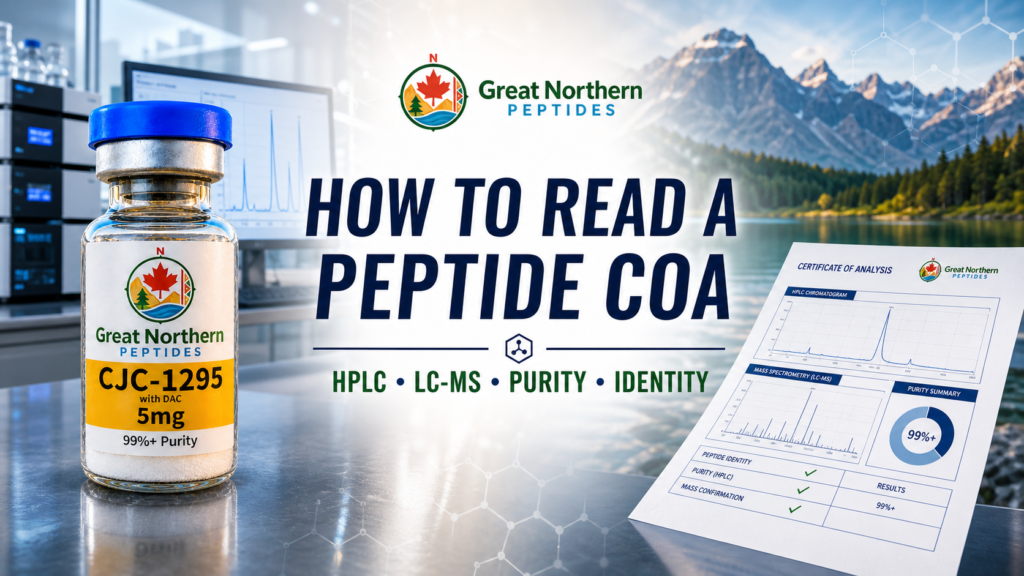
A peptide Certificate of Analysis (COA) is only useful when you know what each result proves—and what it does not. A strong COA connects a specific sample or batch to analytical results for identity, purity and quantity. It should also identify the laboratory, test methods and report date clearly enough that the result can be verified.
The most important distinction is simple: purity, identity and vial content are three different measurements. A peptide can show a high chromatographic purity percentage without that result proving the compound’s identity, the total milligrams in the vial, sterility or freedom from endotoxins.
This guide explains how to read a peptide Certificate of Analysis, what HPLC and LC-MS results mean, and which details separate a useful batch report from a decorative piece of paper. If you are new to the subject, start with our guide to what peptides are and how they work.
What Is a Peptide Certificate of Analysis?
A Certificate of Analysis is a laboratory report summarizing the tests performed on a sample and the results obtained. In peptide research, a COA may include:
- sample or accession number;
- peptide name and reported strength;
- lot or batch identifier;
- date received and date tested;
- analytical methods used;
- chromatographic purity;
- molecular-mass or identity confirmation;
- measured net peptide content;
- laboratory name and report authorization.
Not every COA contains every test. The correct question is not simply, “Does it have a COA?†It is, “Which quality attributes were actually measured?â€
The Three Results That Should Never Be Confused
1. Peptide identity
Identity testing asks whether the sample contains the molecule it is claimed to contain. Mass spectrometry is commonly used because it can compare the observed molecular mass with the mass expected for the target peptide. More advanced MS/MS analysis can provide additional structural information by examining peptide fragments.
An identity match does not automatically determine purity or vial quantity. It confirms that a signal consistent with the expected molecule was detected under the stated method.
2. Peptide purity
Purity testing asks how much of the material detected by a particular method is represented by the main peptide peak rather than related impurities. Reverse-phase high-performance liquid chromatography (RP-HPLC) is frequently used to separate components according to how they interact with the column and mobile phase.
A result such as “99.2% purity by HPLC†normally refers to chromatographic peak-area purity under the conditions used. It does not mean that 99.2% of everything inside the vial is active peptide by total mass. Water, salts, counterions or materials that are poorly detected by the method may not be represented in the same way.
3. Net peptide content or quantity
Quantity testing asks how much peptide is present. A properly validated quantitative method uses calibration, a characterized reference standard or another defensible value-assignment approach. This result may be reported in milligrams per vial or as a percentage of the label claim.
This is why a COA showing only “99% purity†cannot prove that a vial labelled 10 mg actually contains 10 mg. Purity and quantity answer different questions.
How HPLC Works on a Peptide COA
High-performance liquid chromatography passes a dissolved sample through a column under controlled conditions. Different components move through the system at different rates, producing peaks on a chromatogram.
When reading an HPLC section, look for:
- the main peak: the dominant signal attributed to the target peptide;
- retention time: when the component exited the column;
- minor peaks: potential related substances or impurities;
- peak-area percentage: the relative area assigned to the primary peak;
- method information: column, detector wavelength, solvents and gradient, when supplied.
Retention time alone is not definitive proof of identity because different compounds can sometimes behave similarly. HPLC becomes more informative when paired with mass spectrometry and a suitable reference standard. Scientific reviews of peptide quality testing likewise describe chromatography, mass spectrometry and well-characterized standards as complementary rather than interchangeable tools (Reference Standards to Support Quality of Synthetic Peptide Therapeutics).
What LC-MS and Mass Spectrometry Tell You
Liquid chromatography–mass spectrometry combines separation with mass detection. The LC stage helps separate components; the MS stage measures mass-to-charge ratios. Together they can support identity confirmation and reveal peptide-related impurities that a basic purity percentage may not fully characterize.
On a report, compare:
- theoretical or expected molecular mass;
- observed molecular mass;
- the stated mass tolerance;
- whether the reported ion pattern is consistent with the peptide;
- whether MS/MS sequencing or fragment confirmation was performed.
LC-MS is a powerful peptide-analysis method, but interpretation still depends on sample preparation, instrument settings, standards and method validation. A mass match is not a standalone guarantee of sterility, potency or exact vial fill. For a technical overview, see this review of synthetic peptide characterization using LC-MS.
What “99% Peptide Purity†Really Means
A 99% result can be meaningful, but only when the report tells you:
- which method produced the percentage;
- which detector and integration rules were used;
- whether the main peak was identity-confirmed;
- whether the sample was tested by an independent laboratory;
- whether the result is tied to the batch being evaluated.
The percentage should never be read as a universal safety score. HPLC purity generally does not address microbial contamination, endotoxins, heavy metals, residual solvents or particulates unless separate tests are listed.
Additional Tests a COA May Include
Endotoxin testing
Endotoxins are bacterial cell-wall components. They require a dedicated test and are not excluded by a high HPLC purity result.
Sterility or microbial testing
Sterility testing evaluates viable microbial contamination under defined conditions. A visually clear vial is not evidence of sterility.
Water content
Residual moisture can affect solid-state peptide stability. Karl Fischer titration is one method used to quantify water.
Residual solvents and counterions
Peptide synthesis and purification can leave solvents or counterions. These require appropriate dedicated methods and may affect total mass calculations.
Appearance and pH
Appearance and pH can be useful specifications, but they cannot replace chemical identity, purity or quantity testing.
How to Verify That a COA Matches the Product
Use this six-point check:
- Match the compound name. Pay attention to variants, salt forms and modifications.
- Match the batch or COA number. A generic report from another lot is weaker evidence.
- Check the dates. Confirm when the sample was received and analyzed.
- Identify the laboratory. The report should provide a real laboratory and traceable accession number.
- Separate the results. Look independently for identity, purity and net content.
- Review the methods. A percentage without an analytical method has limited value.
Testing describes the sample at the time it was analyzed. Proper handling afterward still matters. Our peptide storage and stability guide explains how temperature, light, moisture and repeated handling can affect peptide material after testing.
Common COA Red Flags
- no batch, lot or accession number;
- no laboratory name or verification route;
- a purity percentage with no stated method;
- one result presented as proof of identity, purity, quantity and sterility;
- a report date that does not correspond to the current batch;
- altered, cropped or unreadable chromatograms;
- a reported vial quantity without describing a quantitative method;
- identical COAs reused across unrelated products.
How Great Northern Peptides Uses Batch Testing
Great Northern Peptides publishes available laboratory results with product information so researchers can compare the labelled compound with the analytical report. When reviewing any product, use the same standard: verify the batch, identify the tests performed and avoid treating a single purity number as the whole quality picture.
You can explore our broader explanation of peptide types and quality-testing methods, or use the comparisons of CJC-1295 with DAC, without DAC and ipamorelin and Semax versus Selank to see why confirming the exact molecular identity matters.
Frequently Asked Questions About Peptide COAs
Does 99% purity mean a peptide vial contains the correct milligrams?
No. HPLC purity is normally a relative chromatographic measurement. Confirming milligrams per vial requires a separate quantitative result using an appropriate validated method or reference standard.
Can HPLC confirm peptide identity?
HPLC can support identification by retention behaviour, but retention time alone is not definitive. Mass spectrometry or another orthogonal identity method provides stronger confirmation.
Does mass spectrometry prove peptide purity?
Mass spectrometry can confirm expected molecular mass and characterize impurities, but a mass match alone is not a complete purity or quantity result. LC and MS data are strongest when interpreted together.
Does a COA prove that a peptide is sterile?
Only if the report includes an appropriate sterility or microbial test. Identity and HPLC purity tests do not establish sterility or endotoxin status.
Why should the batch number on a COA match the vial?
Analytical results apply to the sample that was submitted. Matching identifiers provide traceability between the tested sample, the reported batch and the material being evaluated.