

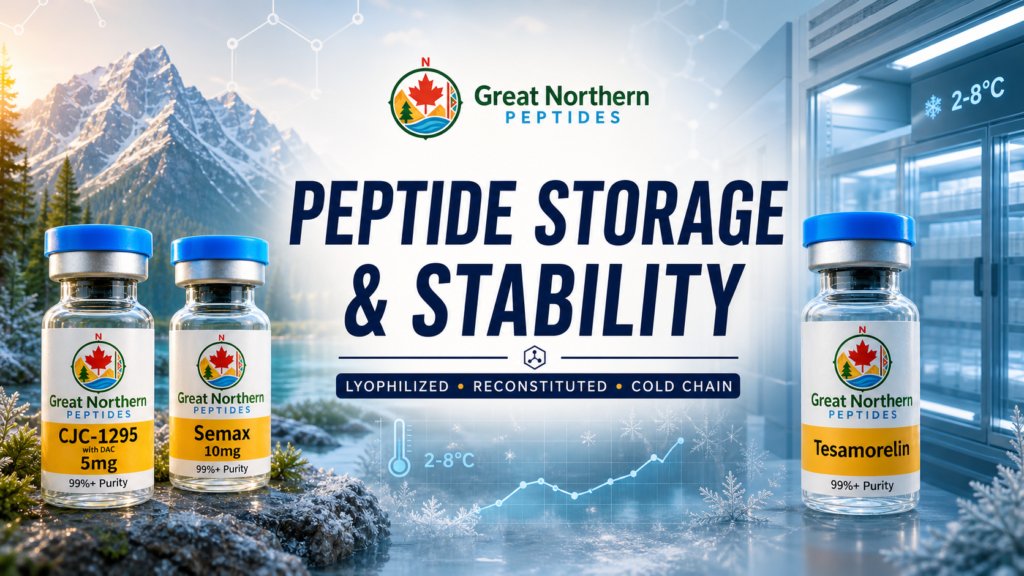
Peptide storage and stability depend on the molecule, formulation and physical state. Lyophilized peptide material is generally more stable than the same peptide in solution, but freeze-drying does not make a peptide indestructible. Temperature, moisture, oxygen, light, pH, agitation and repeated freeze-thaw cycles can all influence degradation.
The safest general rule for research laboratories is to follow the product-specific storage specification, minimize unnecessary handling and document every temperature excursion. This guide explains the underlying principles so researchers can understand why those instructions matter.
If you are still learning the basics, review what peptides are and our guide to reading a peptide Certificate of Analysis.
Quick Guide to Peptide Storage
- Use the compound-specific specification. There is no universal storage temperature or shelf life for every peptide.
- Keep lyophilized material dry. Moisture can increase molecular mobility and accelerate solid-state degradation.
- Protect sensitive peptides from light and oxygen. Susceptibility depends on sequence and formulation.
- Minimize time at uncontrolled temperatures. Record excursions rather than guessing that a sample is unaffected.
- Avoid unnecessary agitation and freeze-thaw cycles. Interfaces and physical stress can promote aggregation.
- Label every prepared solution. Record concentration, solvent, preparation date, storage condition and freeze-thaw history.
Why Peptides Degrade
Peptides are chains of amino acids joined by peptide bonds. Their chemical and physical stability varies with sequence, structure, concentration and surroundings. Common degradation pathways include:
- oxidation of susceptible residues;
- deamidation of asparagine or glutamine residues;
- hydrolysis or cleavage of peptide bonds;
- aggregation or self-association;
- adsorption to glass, plastic or air-liquid interfaces;
- light-driven reactions in photosensitive sequences;
- microbial contamination after preparation when handling controls are inadequate.
A scientific review of peptide aggregation identifies sequence, pH, concentration, excipients, surfaces, agitation, temperature and lyophilization as interacting stability variables rather than isolated factors (Factors Affecting the Physical Stability of Peptide Therapeutics).
Lyophilized Peptide Storage
What lyophilization does
Lyophilization removes water under controlled freezing and vacuum conditions, leaving a dry peptide cake or powder. Reducing water can slow many degradation reactions and improve shipping and storage stability. However, reactions can still occur in the solid state, especially when residual moisture, temperature or formulation conditions are unfavourable.
Research on solid-state proteins and peptides identifies oxidation, deamidation, bond cleavage and aggregation as possible pathways, with temperature, moisture and formulation state influencing the rate (Solid-State Chemical Stability of Proteins and Peptides).
Protect lyophilized material from moisture
Do not assume an intact-looking cake is unaffected by humidity. Keep the container sealed as specified, avoid opening it in a humid environment and allow a very cold sealed vial to equilibrate before opening when the protocol requires it. Opening a cold container can permit condensation to form on the material.
Control temperature and light
Storage temperatures should come from product-specific stability information. “Cool and dark†is a useful general concept, but it is not a substitute for a defined range. Use monitored storage equipment and protect light-sensitive materials with secondary packaging or amber containers when specified.
Peptide Stability After Reconstitution
Dissolving a peptide increases molecular mobility and exposes it more directly to water, oxygen, container surfaces and pH-dependent reactions. That is why stability in solution is usually more limited and more formulation-dependent than stability of a lyophilized solid.
Use the specified solvent and concentration
Solvent composition and pH can change solubility, charge, aggregation and chemical degradation. Do not substitute one diluent for another merely because both appear clear. Follow the research protocol or supplier specification for the particular compound.
For concentration calculations, the peptide calculator can help researchers check the arithmetic associated with vial size and reconstitution volume. It does not determine chemical stability or establish a validated preparation protocol.
Label prepared solutions completely
A useful research label records:
- compound and batch;
- final concentration;
- solvent or buffer;
- date and time prepared;
- storage temperature;
- operator initials;
- number of freeze-thaw cycles, if applicable.
Minimize unnecessary handling
Repeated warming, cooling, shaking and transferring can expose the solution to new surfaces and physical stress. If a validated protocol allows frozen aliquots, dividing material into task-sized portions can reduce repeated freeze-thaw events. Not every peptide tolerates freezing, so aliquoting should follow compound-specific evidence.
Refrigeration Versus Freezing
Neither refrigeration nor freezing is universally correct for every peptide solution.
- Refrigeration can slow many reactions while avoiding ice formation, but it does not stop degradation.
- Freezing can extend stability for some formulations, but ice formation concentrates solutes into the unfrozen phase and can shift pH or promote aggregation.
- Ultra-low-temperature storage may be suitable for validated long-term research archives, but containers, buffers and thawing procedures still matter.
The correct decision comes from real-time or accelerated stability data for the exact peptide and formulation—not from a generic chart copied from another compound.
Temperature Excursions During Shipping or Handling
A temperature excursion does not automatically prove that a peptide is degraded, but it should not be ignored. Record:
- the highest and lowest observed temperature;
- the estimated duration;
- whether the material was solid or in solution;
- whether the package remained sealed and dry;
- any product-specific excursion allowance;
- the decision to retain, quarantine or retest.
When the impact matters, analytical retesting is stronger evidence than appearance alone. The methods discussed in our peptide COA guide can help distinguish identity, purity and quantity testing.
Light, Oxygen and Container Choice
Light exposure
Some amino-acid residues and formulation components are photosensitive. Use appropriate secondary packaging and keep exposure brief when a product is marked light-sensitive.
Oxygen exposure
Oxidation risk depends on peptide sequence, dissolved oxygen, headspace, metals, pH and time. Repeatedly opening a container increases exchange with the environment.
Adsorption to surfaces
At low concentrations, loss to glass or plastic surfaces can become analytically significant. Low-binding containers, suitable excipients and controlled contact surfaces may be needed in validated methods.
Does Cloudiness Mean a Peptide Is Degraded?
Cloudiness, particles, colour change or unexpected precipitation can indicate a problem, but visual appearance cannot identify the cause. It might reflect aggregation, insolubility, contamination, buffer incompatibility or temperature stress.
The reverse is also important: a clear solution is not proof that identity, purity or sterility has been maintained. Quarantine material with unexpected appearance and investigate according to the laboratory’s quality procedure.
Peptide Storage Checklist for Research Labs
- Confirm the compound-specific storage specification.
- Record batch and receipt date.
- Inspect packaging before storage.
- Use monitored storage with excursion records.
- Protect from moisture and light as specified.
- Use the correct solvent, buffer and container.
- Label prepared material completely.
- Limit agitation and repeated transfers.
- Track freeze-thaw history.
- Retest or quarantine material when an excursion cannot be justified.
These principles apply whether a project involves CJC-1295 and ipamorelin, tesamorelin comparisons or Semax and Selank. The exact condition and allowable holding time must still be established for the individual molecule and formulation.
Frequently Asked Questions About Peptide Storage
Do all lyophilized peptides need the same storage temperature?
No. Sequence, formulation, residual moisture, packaging and stability data differ. Always use the storage specification for the exact product rather than a universal temperature chart.
Are lyophilized peptides more stable than reconstituted peptides?
Generally, removing water slows many degradation pathways, so lyophilized material is often more stable. It can still be affected by heat, moisture, oxygen and light.
Can a peptide solution be frozen repeatedly?
Repeated freeze-thaw cycles can promote aggregation or chemical change in some formulations. Use validated aliquoting and thawing procedures when freezing is supported for the compound.
How can researchers tell if a peptide degraded?
Unexpected colour, particles or precipitation are warning signs but are not definitive. Analytical comparison using methods such as HPLC and LC-MS provides stronger evidence than visual inspection.
Does refrigeration stop peptide degradation?
No. Refrigeration can slow many reactions, but it does not stop them. Stability still depends on time, formulation, pH, concentration, oxygen, light and handling.